

-
This teaching approach positions the development of reflexive capacity as its methodological foundation. Rather than treating reflexivity as a procedural requirement, the course reframes it as central to how research questions are formed, how knowledge is interpreted, and how researchers understand their relationship to the work.
The innovation operates at two interconnected levels.
Structured Self-Mapping
The course opens with a guiding question: Whose epistemology has shaped who you are? Students engage with this question through sustained reflexive journalling, tracing the cultural, familial, spiritual, and affective sources of their knowledge before they are asked to design research questions. This sequencing is deliberate. By positioning epistemological self-examination as the entry point into research, the course shifts reflexivity from an add-on to a foundational practice.Poetic and Collaborative Inquiry
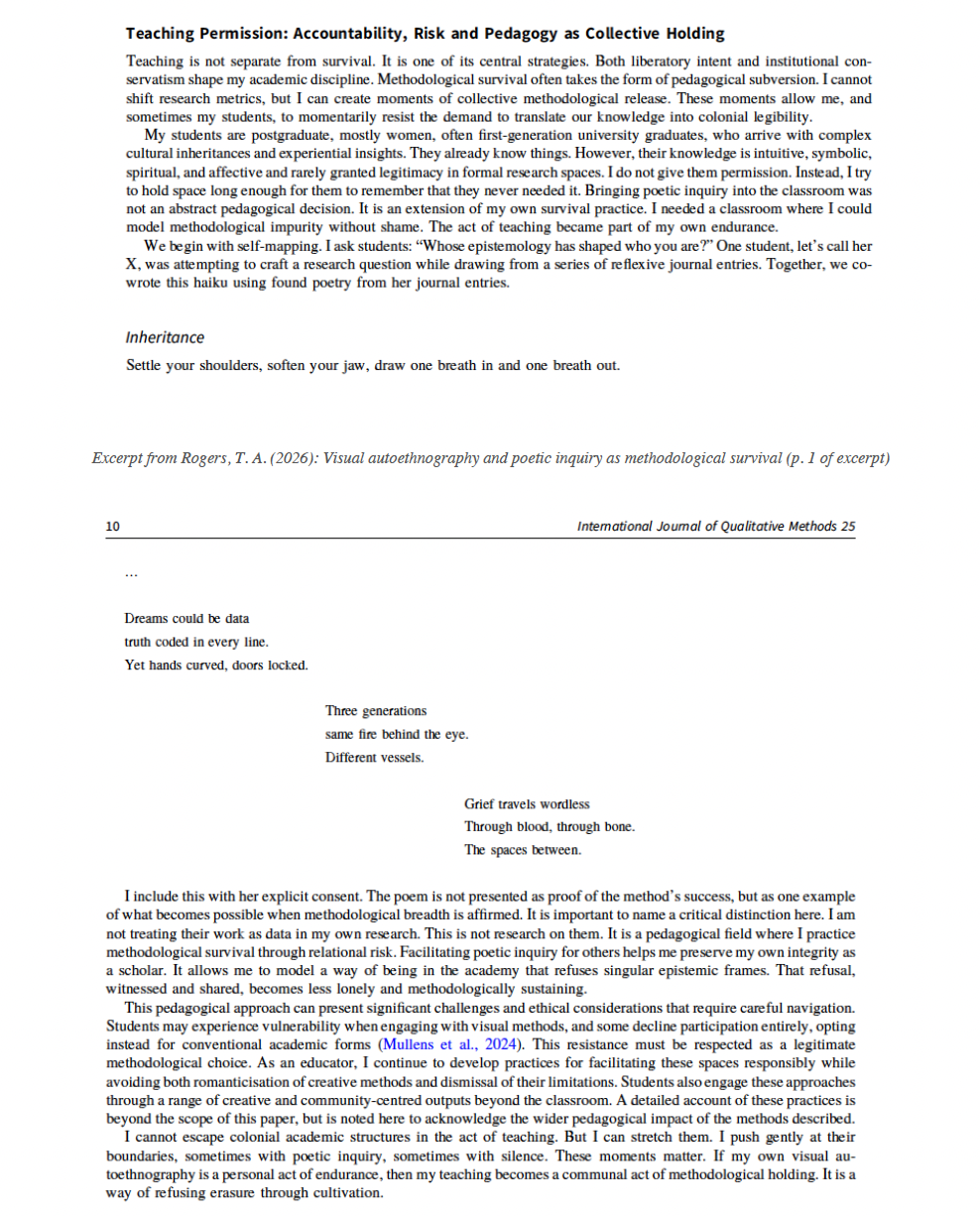
Students are introduced to found poetry and collaborative poetic inquiry as methods for articulating positionality. These approaches provide alternative pathways for students to access and express forms of knowing that may not emerge through conventional academic writing.In one instance, a student working to develop a research question drew on a series of reflexive journal entries. Through a collaborative process, we co-constructed a haiku using language from those entries. The poem captured intergenerational transmission of knowledge, grief, and aspiration in ways that conventional prose had not been able to hold. The student’s explicit consent to include this work in subsequent scholarship reflects the relational and ethical care with which this pedagogical space is structured. The classroom is not treated as a site of data extraction, but as a space for methodological practice grounded in trust and responsibility.
This approach is documented and theorised in a peer-reviewed article (Rogers, 2026), which further situates these practices within broader methodological and epistemological debates.
-
This approach enhances student learning by:
affirming the legitimacy of intuitive, symbolic, cultural, and affective knowledge as valid starting points for research inquiry
developing reflexive capacity as an ongoing methodological practice rather than procedural compliance
enabling students to construct research questions that are epistemologically aligned with their positionalities and the communities they study
equipping students with methodological tools such as reflexive journalling, poetic inquiry, and collaborative analysis
creating a learning environment in which students who have been marginalised within formal knowledge systems recognise themselves as capable and legitimate researchers
Students develop not only technical competence in research design, but also an epistemological confidence grounded in their own lived experience. This foundation supports research that is both methodologically rigorous and contextually responsive within Caribbean and Global South contexts.
-
The core innovation, positioning epistemological self-examination as the entry point into research training, is transferable across disciplines in which students engage in research involving people, communities, and social processes.
Fields such as education, public health, sociology, psychology, and anthropology all require researchers to critically examine how their identities, assumptions, and cultural inheritances shape the knowledge they produce. The structured self-mapping and reflexive journalling processes can be implemented with minimal resources and adapted across disciplinary contexts.
The use of poetic inquiry as a methodological tool is similarly accessible and adaptable. The accompanying publication provides a scholarly foundation that supports educators in understanding both the rationale for this approach and the ethical considerations required for its implementation.
Together, these practices demonstrate how reflexivity and positionality can be taught as living methodological commitments rather than procedural requirements, producing researchers equipped to work with integrity across complex social and cultural contexts.
This teaching practice is embedded in the graduate Social Work Research course at the University of the West Indies, Mona Campus. Students in this course are predominantly postgraduate women, many of them first-generation university graduates, who arrive carrying complex cultural inheritances and forms of experiential knowledge that conventional research training rarely validates. Standard research instruction in the social sciences often treats reflexivity as a procedural requirement rather than a substantive methodological practice, and positionality statements as formulaic disclosures rather than sites of genuine epistemological inquiry. This teaching practice responds to that inadequacy by reconceptualising reflexivity and positionality as core research competencies rooted in the question of whose knowledge counts and on whose terms.
Teaching Reflexivity and Positionality in Social Work Research
Peer-reviewed publication documenting the pedagogical and methodological approach
Student-generated reflexive and creative outputs, including poetic inquiry
Observed development of research questions that demonstrate deeper epistemological alignment and critical engagement
Student reflections indicating increased confidence, clarity, and ownership of their research process
Evidence
Student Reflection Series

Dr. Rogers’ courses challenged me both academically and personally throughout my Master of Social Work journey. What has stayed with me most is her emphasis on reflective practice, which has shaped how I approach both my professional work and personal growth. Her creative use of role plays with real actors to simulate real life challenges, along with interactive and thought provoking class discussions and assignments, allowed me to actively engage, critically analyze diverse perspectives, and bridge theory with practice. These experiences have strengthened my confidence in engaging with clients even when sitting in discomfort, as well as my critical and reflective thinking, and continue to influence how I work with clients today.
— Kechell Samanta Felix, MSW
Division of Social Services, Ministry of Social Development & Housing, Grenada