
Arts-Based Pedagogy: Collage as a Pathway to Epistemic Self-Trust in Research Training
This teaching practice is embedded in a graduate Social Work Research Bootcamp course I developed for my students. When asked to identify research topics through traditional methods, graduate students frequently display patterns of uncertainty, self-doubt, and constraint that go beyond ordinary academic anxiety. These patterns often reflect a deeper dynamic: the internalised belief that cultural, affective, or embodied ways of knowing are illegitimate within academic spaces. This phenomenon, theorised here as epistemic shame, is pedagogically reproduced through academic practices that privilege disembodied, linear modes of analysis and treat personal and political histories as detractors rather than resources in the research process. This teaching practice responds to that dynamic directly, using collage-making as a structured arts-based intervention to interrupt epistemic shame and create conditions for students to access embodied knowledge as a legitimate research resource.
-
This approach introduces collage-making as a reflexive research practice within graduate research methods instruction. The innovation is grounded in feminist epistemology and decolonial pedagogical commitments, and theorises three interconnected concepts that reframe how research capacity is understood and cultivated: epistemic shame as a pedagogical barrier, epistemic self-trust as a pathway to reintegration, and embodied knowledge as a research resource.
In practice, students are invited to create collages as a method of surfacing research interests before committing to formal question development. The collage-making process engages somatic cues, affective responses, and non-linear associations. These are the forms of knowing that conventional research training tends to suppress. By working with image, texture, and composition rather than academic prose, students access dimensions of their intellectual and experiential selves that structured question-development exercises routinely foreclose.
Students are given approximately 30 to 40 minutes to construct a collage representing themes, images, and questions that resonate with their emerging research interests. They then write brief reflective notes explaining the connections between their visual composition and the issues they feel drawn to investigate. These reflections become the starting point for facilitated dialogue in which students articulate how their personal, cultural, and political experiences shape their research questions.
The intervention, when situated within explicit theoretical commitments to epistemic justice, collage-making functions as a diagnostic practice that exposes the limits of dominant forms of inquiry while providing students with experiential access to alternative epistemologies. The process enables what the educator theorises as epistemic repair: the reintegration of ways of knowing that students had previously rejected or suppressed within academic contexts.
This practice is being documented and theorised in a manuscript currently in preparation, co-authored with a colleague: Rogers, T. A., & Lubin Langtiw, C. (in preparation). Your body is your first research site: Collage as a pathway from epistemic shame to epistemic
self-trust.
-
This approach enhances student learning by:
• Interrupting epistemic shame, enabling students to approach research design from a position of self-trust rather than self-doubt
• Providing structured access to embodied knowledge as a legitimate research resource, expanding the epistemological range available to emerging researchers
• Supporting students in developing research topics that are genuinely connected to their intellectual curiosity, cultural inheritances, and lived experience
• Increasing students’ willingness to integrate personal and political histories into their scholarly work in rigorous and theoretically grounded ways
• Strengthening reflexive capacity by engaging students in meaning-making processes that operate before and alongside academic language
Student outcomes documented through this practice include greater connection to research topics, increased willingness to draw on personal and political histories in scholarly work, and enhanced capacity for reflexivity.
-
The collage intervention requires no specialist equipment or artistic training beyond access to magazines, paper, and adhesive. This makes it one of the most practically accessible innovations in this portfolio. Its theoretical underpinnings, epistemic shame, epistemic self-trust, and embodied knowledge, are applicable across any graduate programme in which students are asked to generate original research, including education, public health, psychology, anthropology, and the humanities.
The framework this practice produces is also transferable in a deeper sense: it offers
educators across disciplines a conceptual vocabulary for naming and responding to the epistemic barriers their students carry. Rather than treating student uncertainty as a deficit of preparation or confidence, this approach repositions it as a pedagogically addressable response to structural conditions. That reframing is available to any educator willing to work within explicit commitments to epistemic justice.
These practices demonstrate how arts-based methods can be integrated into graduate research training as rigorous epistemological interventions that expand students’ capacity to produce knowledge that is both methodologically sound and intellectually honest.
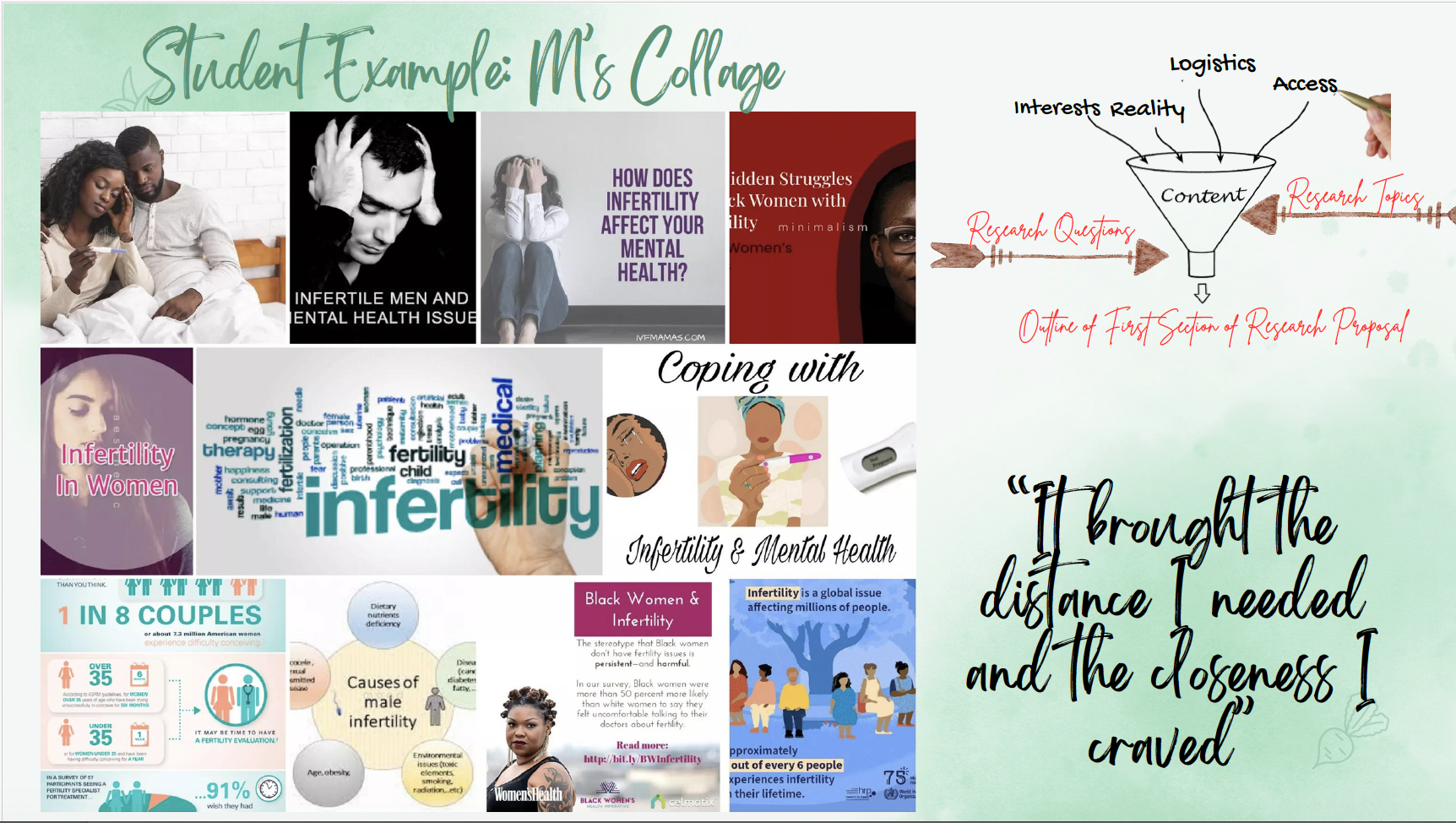
Evidence: Student Collage

Dear Dr Rogers,
I am so grateful for our many collaborations over the years. I am especially grateful for your generosity guest lecturing in my Qualitative Research Methods and Expressive Therapies. In particular your presentation on March 18, 2025 was instrumental in my Expressive Therapies course. My doctoral students in clinical psychology have consistently been nurtured and challenged by your innovative ideas. Thank you always!
Warmth,
Cynthia Langtiw-Lubin, PsyD
Haitian American Clinical and Community Psychologist, Full Professor, Clinical PsyD Program, The Chicago School - College of Professional Psychology

Student Reflection Series
Dr Rogers' courses and supervision have both deepened my understanding of social work as both a reflective and practice-based discipline, pushing me to think more critically about the complexities of working with individuals and communities. I found the emphasis on ethical decision-making, social work values, and evidence-informed practice especially valuable, as it shaped how I approach real-world situations. What stayed with me most was the importance of being both intentional and self-aware in my interactions, recognizing the impact of my role and perspective. Overall, the experience strengthened my ability to think analytically while remaining grounded in compassion and professional responsibility.
—Phiona Smike, MSW
UWI, Mona, Class of 2025