Grief as Refusal: the work came from somewhere
We opened the reasoning the way I often want Saltwater Reasonings to open: with a text that does not behave like an "icebreaker", but like a threshold. I read James Baldwin aloud, holding on to his insistence that after departure, what remains is invisible: memory, loss, love; "invisible chains" that hold the world together. Zaira met Baldwin with Junie Désil, a Haitian Canadian poet, offering a stanza that felt like a second door into the same room: strange inheritance, salt sea, racing rivers, umbilical centuries old, bones abridging oceans, triangulated passages.
In that exchange, something shifted. We were not discussing grief as a theme. We were staging it as method: a way of arriving, a way of listening, a way of naming what is carried but not fully "known". What we carry is not only personal loss. It is collective trauma sedimented in water, language and the body.
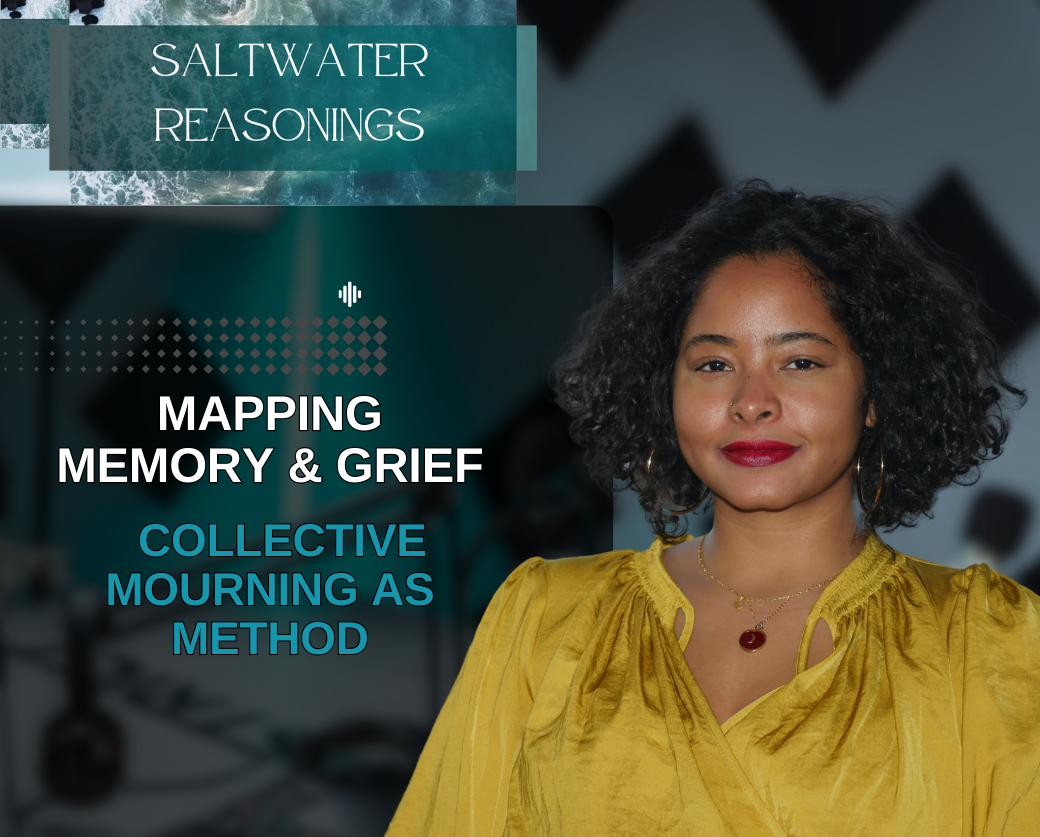
Zaira Simone - Watch Full episode here
I first encountered Zaira's work through my colleague Deborah Mc Fee. Her chapter In Search for Repair: Reflections on Grief, the Repaired and Reparations closes an edited text Deborah and I coedited. The essay examines contemporary institutional claims for reparations against the backdrop of the pandemic's assault on Black lives and her mother's transition. Since reading it, I have been sitting with grief as refusal: refusal of sanitised narratives, refusal of "closure" as institutional demand, refusal of the fantasy that pain must become productive to count as real. And I have been sitting with the grief I hold in the academy.
Grief as the Collapse of False Boundaries
I know what it is to be expected to perform coherence while something is breaking open inside you. To meet institutional deadlines while sitting beside loss. To write emails, teach classes, attend meetings, and submit documents, all while grief presses against the edges of every sentence. The academy does not pause for your personal reckoning. It asks you to compartmentalise, to keep the work moving, to wait for a "more appropriate time" that never arrives.
Zaira described pressing "submit" on a dossier while sitting beside her mother in hospice, then interviewing for jobs days later. Professional life does not wait. What moved me was her refusal to accept that boundary. She named it as “fragile and false”. When winter break came, she stepped away from the obligations that required her to perform coherence. What she did instead was dream. She journalled. She attended therapy. She listened for messages. She described the attentiveness to the dead that sits inside Islamic ritual: instructions, debts, unfinished matters, obligations as someone transitions.
Here, grief was practice. It had protocols. It demanded interpretation. It asked for responsibility.
In the face of academic deadlines, she set aside the revise-and-resubmit as a refusal of the institution's timeline as the primary measure of what mattered. She turned towards a different labour: writing her mother, expanding a eulogy, returning daily to the same document as an act of tending. Grief demanded its own timeline.
Repair after wholeness fails
I have been teaching theories of Black repair, policy formulations, and decolonial visions of collective healing. I teach them seriously because they matter. But I also teach them while carrying losses that have not resolved. I have grieved over and over again the story I had about what being part of the academy would be like. That dream has died many deaths as I work in and through the realities of the academy. And somewhere in that gap between what I am meant to convey and what I actually hold, sometimes … I have felt a quiet fraudulence.
When Zaira named that she was stuck on a passage—"there is no wholeness"—I felt my chest tighten with recognition. She could not embody wholeness while teaching theories of repair. Her grief exposed what many of us recognise but rarely state plainly: repair discourse can become aspirational in ways that erase the severance that loss produces. Some deaths are premature and incomplete. No manifesto can make them whole.
What her grief did was give her permission to recalibrate the questions. Instead of leading with prescriptions, she began asking students: what constitutes wholeness in your life? What makes you feel whole? In a post-pandemic generation shaped by displacement, bereavement became the beginning and the conclusion of classroom dialogue. She called the Caribbean a "grieving geography", drawing from decolonial, Indigenous, and feminist geographical work.
That phrase rooted instantly. I have been circling this in my own teaching: practice without grief becomes administrative. We can teach policy, frameworks, intervention models, but if we never start with the losses that organise Caribbean life, displacement, rupture, land theft, sexual violence, migration, abandonment, environmental vulnerability, then we are teaching technique detached from reality. In our contexts, grief is the context.
Wholeness, Opacity, and Survival inside Institutions
I have learned, repeatedly, that bringing the whole self into the institution is both necessary and dangerous. There is a kind of wholeness that becomes possible when you stop amputating parts of yourself to be tolerated. But there is also extraction. There is surveillance. There is theft. I have had to learn what to share and what to protect.
Zaira named the academy as unsafe: policed syllabi, institutional surveillance, McCarthy-like conditions. Then she offered language I want to keep close: there is power in opacity. There is power in the unseen. Grief, too, often requires opacity. It demands that some things remain unshared, unperformed, protected from extraction.
She also named intellectual theft, especially the theft of Black women's work. Her response was direct: this is where the work came from; these are the reckonings that shaped it; you can call it what you want, but it came from somewhere.
Grief is refusal. Refusal of institutional appropriation. Refusal of being made source material for someone else's legitimacy. Refusal of the idea that knowledge must be "available" to be valuable. Some things must remain withheld to remain ours.
Everyday Repair and the Refusal of Elite Gatekeeping
I often tell my students that their very presence in the classroom is resistance. That the struggle is not only in manifestos or policy documents; it is in showing up, in remembering, in caring for community, in refusing disposability. I tell them this because I believe it. But I also know the academy wants to own the language of repair. It wants repair to be legible, measurable, produced by credentialed experts.
Zaira returned us to a grounded political insistence: people do not wait for justice. They do not endure abuse in stasis. In the absence, delay, or uncertainty of institutional restitution, people claim repair every day. They do not have to call it reparations. They do not need lectures on it. They already have principles, worldviews, survival strategies, and practices of care that respond to the afterlives of slavery and colonialism. Grief as refusal becomes both ethical and methodological here. It refuses elite ownership of concepts like "repair". It refuses the idea that only policy documents count as evidence. It insists that everyday survival is a site of theorising, and that community practice holds intellectual weight.
The Geographies of Grief
By the end we returned to place. I hailed Zaira "from the Republic of Brooklyn", and she accepted the playfulness while naming the violence underneath it: gentrification as settler colonialism, a neighbourhood altered beyond recognition, grief entangled with infrastructure removed.
She described grief on Kent Avenue, on the train, in the cemetery thick with incense and myrrh and Qur'anic recitation. She described dreams that carry addresses of women elders. The departed are not here, but their memory is embedded in the places they moved through.
If the Caribbean is a grieving geography, Brooklyn can be one too. The diaspora has its own saltwater logics: movement, rupture, return, altered landscapes, and memory that refuses to stay in the past tense.
What became clearer

What became clearer to me through this Reasoning is that grief is one of the conditions that make honest thinking possible.
The academy often teaches us to treat grief as private residue: something to be managed quietly so that the work can proceed uninterrupted. But what this conversation reminded me is that grief is already shaping our questions, our silences, our refusals, our hesitations. It is already present in the room. Pretending otherwise only produces a thinner scholarship.
When grief is acknowledged as method, it reorganises what counts as knowledge. It slows the pace of interpretation. It demands accountability to lineage and place. It insists that some questions cannot be rushed simply because an institutional calendar requires an answer.
What Zaira offered was a practice of listening differently: to our ancestors, to unfinished obligations, to landscapes altered by loss, and to communities that have long carried mourning as a political and ethical practice.
That is part of what Saltwater Reasonings is trying to make space for. Conversations that do not begin with the demand to resolve contradiction, but with the willingness to sit inside it.
Grief is one of those contradictions. It reminds us that knowledge comes from somewhere: from places, from people, from histories that are not easily separable from the work we produce.
And perhaps that is the quiet insistence that stayed with me most after this Reasoning.
The work came from somewhere.
So does the grief.
Tune in to Zaira Simone’s full episode Mapping Memory & Grief – collective mourning as method on Spotify and YouTube
Baldwin, J. (1965). This morning, this evening, so soon. In Going to meet the man. Dial Press.
Désil, J. (2020). Eat salt | gaze at the ocean. Talonbooks.
Simone, Z. (2025). In search for repair: Reflections on grief, the repaired and reparations. In D. N. Mc Fee & T. A. Rogers (Eds.), Public policy making, gender, and human security in the Caribbean. Palgrave Macmillan. https://doi.org/10.1007/978-3-031-81592-8_18