Counting Sand, Walking Memory: Saltwater, Return, and the Ethics of Relation
In October 2024, while attending a conference, I visited the Elmina Castle, a slave fort on the Ghanaian coast.
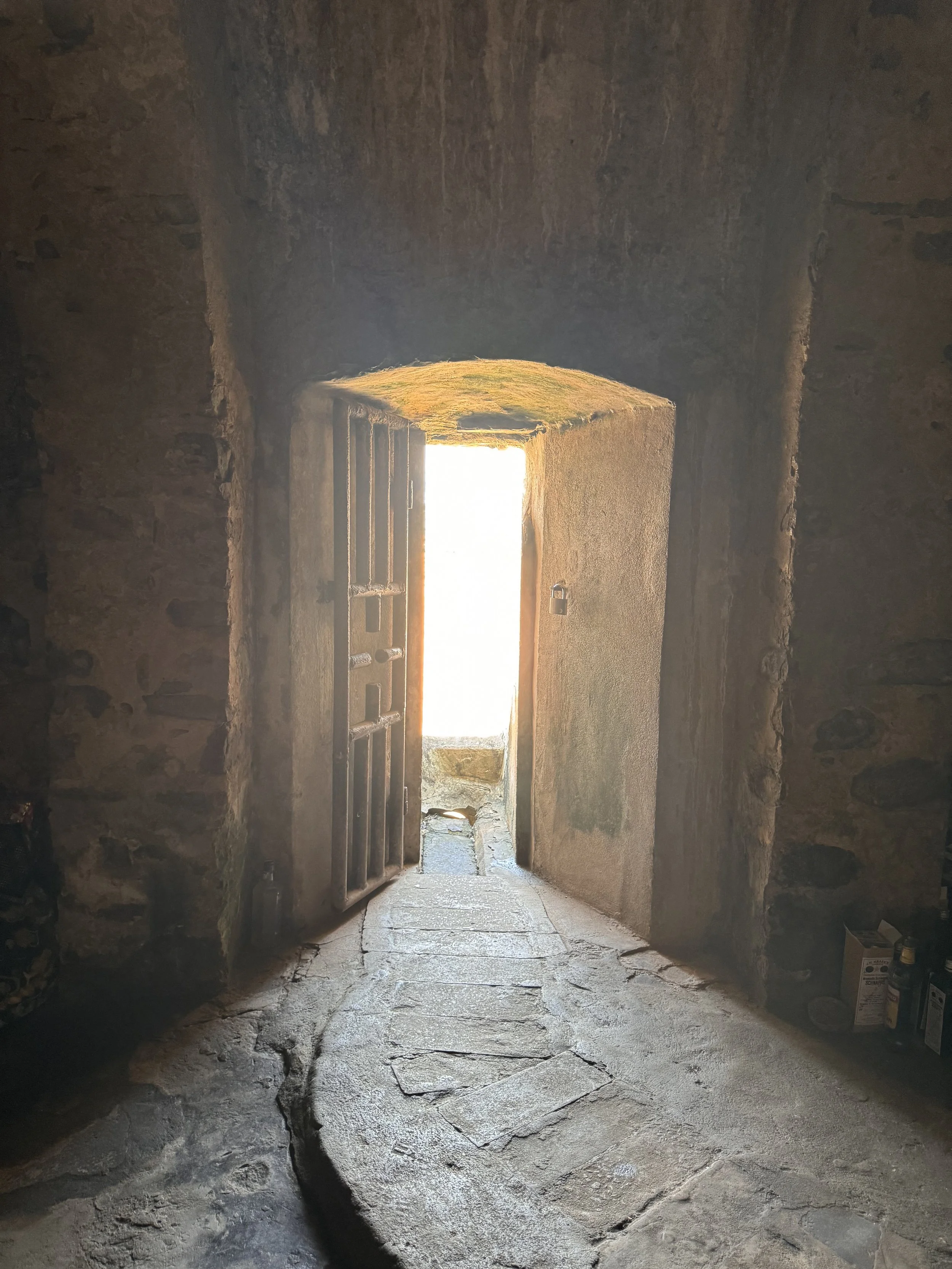
Elmina Castle, fortified castle in Elmina, Ghana
As the conference participants rolled out of the bus, there was a charge in the air, a kind of excitement that made something in me tighten. A friend on the trip chose to stay on the bus, opting out of entering the fort. I did not want to stay. I needed to go in. But I also did not want to participate in the slavery tourism all around me, the packaged experience, the rehearsed narration, the purchase of proximity to pain.
Inside, I moved with the uneasy awareness that I was on a borderland, a nepantla space (Anzaldúa, 2021). I was present to the symbol of the fort, and also keenly aware of the performance unfolding around it, how grief is staged, how history is curated, how visitors are guided through the choreography of witnessing.
I walked through the dungeons. But I refused the upper level where traders lived, where power was domesticated and made ordinary. I could not bring myself to stand where people once looked down at Black bodies as inventory.
Outside, the Atlantic breeze came off the water with a softness that almost offended me. And yet it was there, that contradiction: the ocean as beauty and rupture; water as ceremony and theft; the sea as memory that never closes.
I left with questions about what we owe when we stand at sites of historical violence. About how to honour what happened without allowing the fort to become the origin of everything.
These questions were still with me when I sat down to talk with artist, writer, and scholar Adjoa Armah.
From Return to Relation
Adjoa opened our conversation with an excerpt from Ayi Kwei Armah’s Two Thousand Seasons. It is a passage that refuses the possibility of fully counting, measuring, or accounting for the histories we carry. The quote moves from stars to sand to sea, reminding us that some histories exceed enumeration, some losses exceed record, and some relations cannot be reduced to data.
That opening gesture set the tone for everything that followed.
Adjoa’s work emerges from a personal and diasporic return: born in Ghana, raised in the UK, returning as an adult to conduct research and make art along the Ghanaian coast. What began as visual anthropology research into textiles and photography unexpectedly became an archival project when she discovered that photographic negatives across Accra were being burned and destroyed.
From that moment grew the Saman Archive, named for the Akan word for “ghost”, which is also used to describe the photographic negative itself. The archive now holds thousands of negatives and continues to grow.
But the archive did not become the centre of the work. Instead, it opened a deeper set of questions.
What do we owe one another when we narrate histories of violence?
How do we speak of the slave forts without allowing them to become our point of origin?
How do we find forms of address that speak not only to those who crossed the Atlantic, but also to those who remained?
Rather than centring the fort as monument or origin, Adjoa’s practice turns towards sand, shoreline, erosion, and movement. Sand becomes archive. The beach becomes text. And the story is carried not only by stone, but by fragments, held in bodies, shaped by forces that both preserve and erase.
Sankofa Beyond Tourism
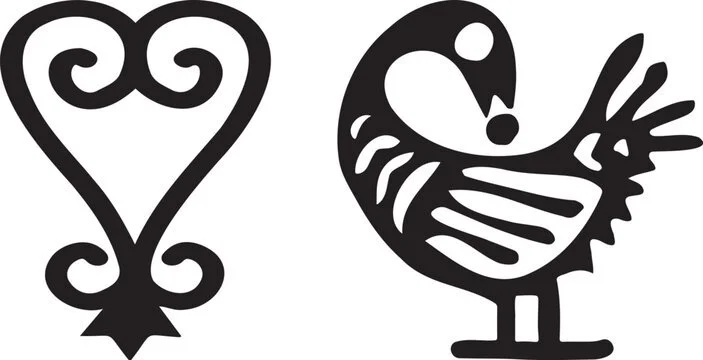
Sankofa symbols
A pivotal moment in our conversation turned towards Sankofa, the Akan concept often translated as “return and get it”. Adjoa offered a careful and necessary critique of how Sankofa is often folded into capitalist logics of heritage tourism and consumption.
Return, she argued, is not simply geographic. True Sankofa demands obligation, continuity, cyclical time, and ethical relation. Return is not a flight. It is a rhythm.
It asks: What do we owe to the future? What do we owe to those who came before? How do we live inside cycles rather than fantasies of linear progress?
That reframing mattered to me in a very immediate way. I returned to Elmina. Return does not require that I have been there before. My ancestors were once on a coast at the mouth of a fort, and in an ancestral sense (and yes in a neurobiological one too), they travel with me.
So my presence there was a kind of return, not a romance with origin, but an encounter with inheritance. In the spirit of Sankofa, I returned to that sand to dip into the wisdom of the body, to listen for what I know, even when I cannot fully explain how I know it.
Grief, Lineage, and the Body as Archive
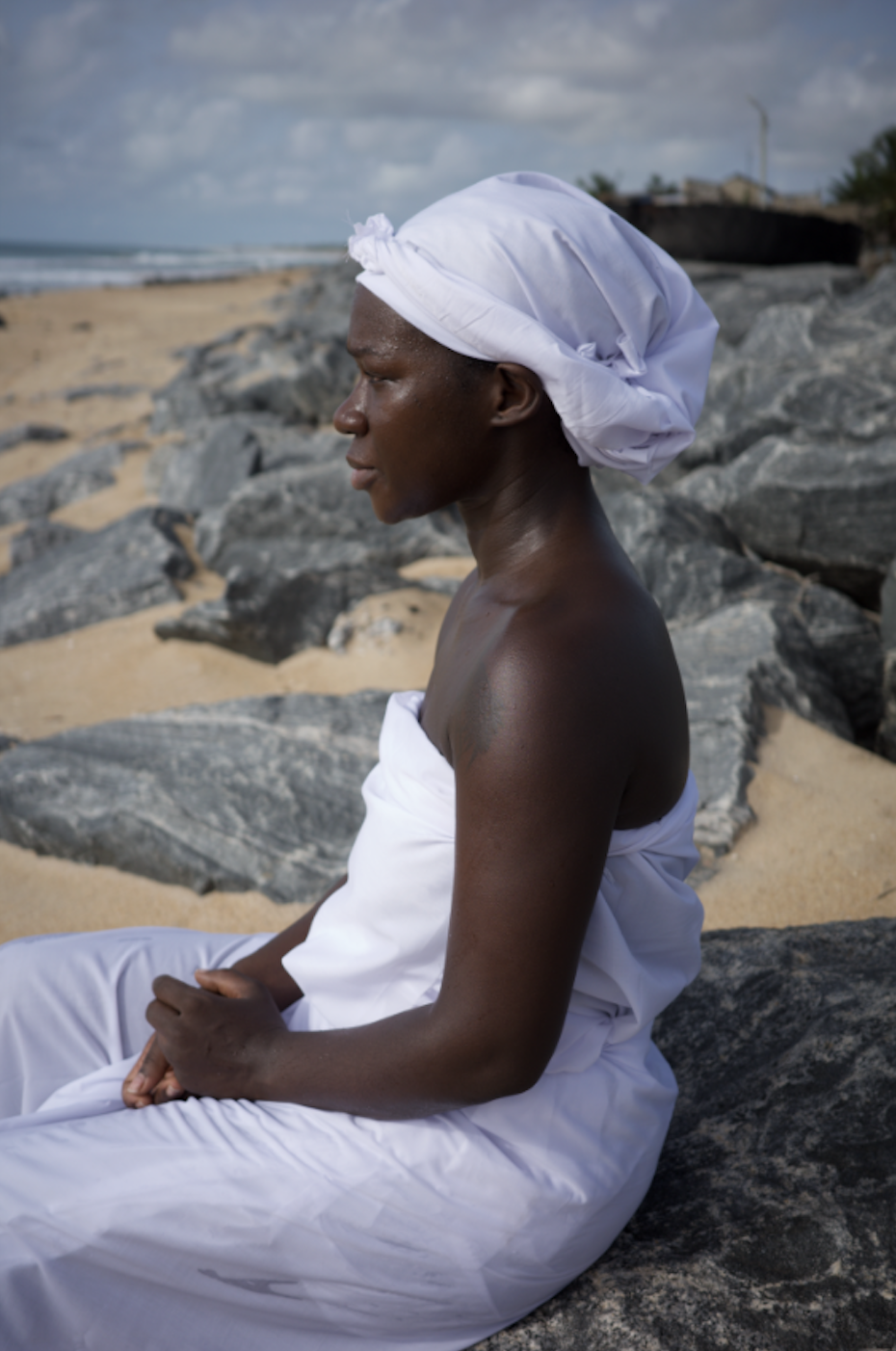
Adjoa Armah
Adjoa spoke of grief as a methodological reality, something that reshapes what becomes speakable and what becomes possible to hold.
She offered a phrase I keep returning to: Every grain of sand was once something larger. Every fragment carries a prior form.
Personal grief and diasporic grief begin to sit inside what Adjoa calls “the same concentric circles”: what is lost, what returns, what cannot be passed on, what reappears in another body.
Performance as Method, Community as Co-Author
Perhaps the most striking dimension of Adjoa’s practice is how rigorously it refuses extractive research.
Across five coastal communities (Osu, Elmina, Ada, Keta, and Cape Three Points), she conducted oral history research by training schoolchildren to interview their own elders. Knowledge did not travel upward to the academy first. It circulated within the community.
Then came sound works broadcast through local information centres, those horn speaker systems used for announcements, sermons, and commerce. Into that everyday infrastructure, she introduced poetry, oral histories, diasporic voices, and fragments of her own writing. History returned to the air.
Performance followed: a walking practice on the shoreline in seventy-seven laps, a number that carries cosmological weight and also stands in for the infinite. As she walks, Adjoa recites seventy-seven fragments: Glissant, Dionne Brand, Saidiya Hartman, Ayi Kwei Armah, elders’ voices, and her own words.
As the tide moves in and out, it erases much of the path she has made.
What remains is partial, as history always is. The impossibility of fully preserving the past becomes part of the work itself.
Words as Inheritance
We closed with Kamau Brathwaite’s Negus, a poem that refuses political freedom without epistemic freedom, without language, and without the right to shape futures through words.
I must be given words to shape my name…
I must be given words so that the bees in my blood’s buzzing brain of memory will make flowers…
In translating Brathwaite into Ewe for broadcast along the Ghanaian coast, Adjoa enacts another return, the return of a Black man born in Barbados whose ancestors were once on a coast at the mouth of a fort.
Sankofa.
What if we return to Africa not as an origin story, but as a living conversation?
After the Tide
What stayed with me most was not any single theory or method, but an ethic, an ethic of refusal, an ethic of care, an ethic of patience with fragments, an ethic of relation over monument.
Art that does not pretend to complete history. A method knows what it cannot hold.
And perhaps that is the deepest lesson of Saltwater Reasoning. Some histories are not meant to be mastered.
They are meant to be walked with.
Listened to.
Returned to.
Again and again.
Like the tide.
Tune into Water Knows the Way: Diaspora, Return and the Sea on YouTube and Spotify
References
Anzaldúa, G. (2021). Borderlands/La frontera: The new mestiza (4th ed.). Aunt Lute Books.
Armah, A. K. (1973). Two thousand seasons. Heinemann.
Brand, D. (2001). A map to the door of no return: Notes to belonging. Vintage Canada.
Brathwaite, K. (1973). Negus. In The arrivants: A new world trilogy. Oxford University Press.
Glissant, É. (1997). Poetics of relation (B. Wing, Trans.). University of Michigan Press.
Hartman, S. (2007). Lose your mother: A journey along the Atlantic slave route. Farrar, Straus and Giroux.